
This FAQ answers the most common questions asked by first-time funders of health justice partnership.

What are the individual and systems outcomes anticipated for health justice partnership and where is there opportunity for work in collaboration with public health researchers to explore this potential?
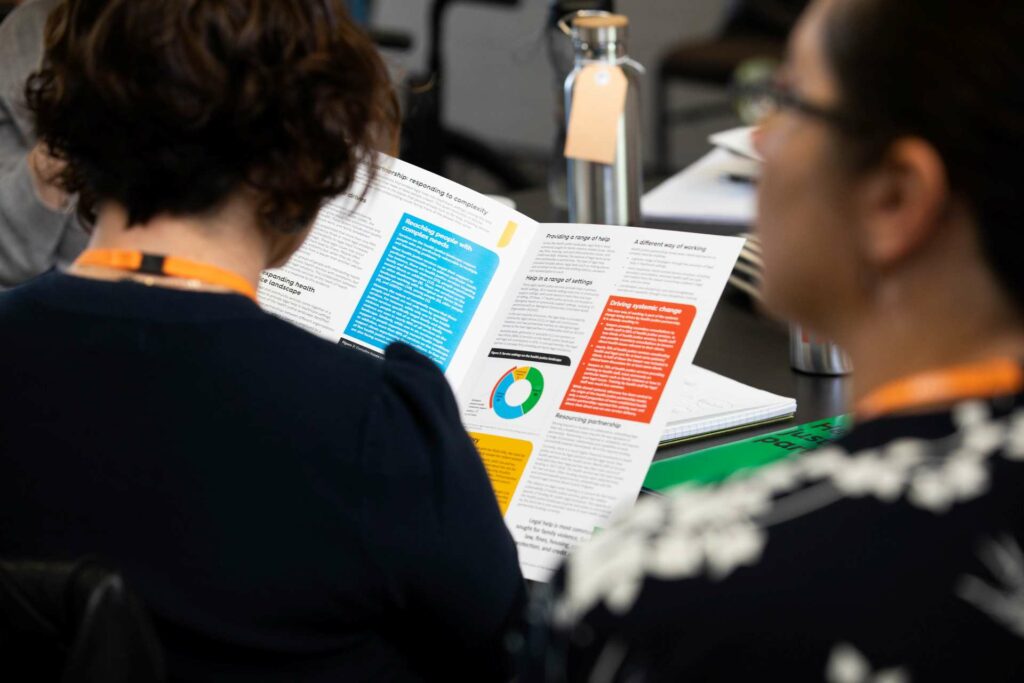
Key messages articulating the evidence so you can communicate the ‘what’ and ‘how’ of health justice partnership to funders and policymakers. Adapt these for your funding applications!

The rationale for health justice partnership
Health justice partnerships (HJPs) embed legal help into healthcare, social and community services and teams. HJPs work to improve health and wellbeing for:
- individuals, through direct service provision in places that they access
- people and communities vulnerable to complex need, by integrating service responses around client needs and capability
- vulnerable populations through advocacy for systemic change to policies and practices that affect the social determinants of health.
Michael Kidd @ Health Justice 2025
Australia’s Chief Medical Officer on health equity, the social determinants, and the importance of partnership and integration across sectors and systems for improved health, justice and wellbeing.
Let's Talk Health Justice
with Dr Liz Curran, Associate Professor of Clinical Legal Education and Research Impact Lead at Nottingham Law School, Nottingham Trent University, UK.
Dr Curran has been researching, writing about, and advocating for health justice partnership for over 20 years. In this episode, Dr Curran speaks about her vast experience and the changes she has observed across the HJP landscape.
When seeing a lawyer is good for your health
Many health professionals are surprised to realise that the issues they see day to day may have legal solutions that can be remedied by lawyers. Hear from leading health professionals and healthcare executives on the role of health justice partnership in their work.
Our published research
Schram, A., et al. (2021). Advancing action on health equity through a sociolegal model of health. The Milbank Quarterly, 99(4), 904-927.
Forell, S., & McCarron, E. (2024). Health justice partnership: Access to justice meets health equity. Alternative Law Journal, 49(3), 168-173.
Tobin-Tyler, E., Boyd-Caine, T., Genn, H., & Ries, N. M. (2023). Health Justice Partnerships: An international comparison of approaches to employing law to promote prevention and health equity. Journal of Law, Medicine & Ethics, 51(2), 332-343.